
P: OCCUPATIONAL LEVEL
Choose column P of the employee information Excel sheet.
Use Addendum 1 (EEA9) if you have a grading system implemented to correlate between your grading system and the occupational levels:
Input the occupational level of the employee as per the EEA9 (definitions).


If you copy and paste from your own sheet, ensure your naming for [Top Management] [Senior Management] [Middle Management] [Junior Management] [Semi-Skilled] or [Unskilled] is exactly the same as in the example above. Do not substitute [Top Management] [Senior Management] [Middle Management] [Junior Management] [Semi-Skilled] or [Unskilled] with anything else, like abbreviations, for example: [TM] [SM] [MM] [JM] [SS] or [US].
According to the EEA9, occupational levels are defined as follows:
Top Management or Executives
- Controls the functional integration of the business.
- Determines the overall strategy and objectives of the business.
- Directs the company into the future.
- The nature of the work and focus is long-term.
- Signs off on policies or strategies.
Senior Management
- Knowledge of entire business area, business unit, company or group.
- Provide inputs for the formulation of the overall organisational strategy.
- Translates the overall strategy into business plans for business- or functional unit, thereby operationalising the organisational strategy.
- Implements and manages the business plan, goals and objectives and ensures the achievement of overall key organisational, business unit or functional outputs.
- Manages the development of innovation and change.
Middle Management: Professionally qualified and experienced specialists
- Professional knowledge of sub-discipline or discipline.
- Provide input in the formulation of organisational or functional unit business plans.
- Formulate and implement departmental and or team plans that will support the business unit business plans.
- Optimisation of resources (finances, people, material, information and technology) to achieve given objectives in most productive and cost-effective way.
Junior Management: Skilled Technical and Academically Qualified / Supervisors / Foremen / Superintendents
- Applies broad knowledge of products, techniques and processes.
- Evaluates procedures and applies previous experience.
- A good solution can usually be found.
- Determines own priorities.
- What must be done is stipulated but may require initiative in terms of how it should be done.
Semi-Skilled and discretionary decision-making
- Accountable for direct product, process or service quality.
- Incremental improvement of existing processes and procedures according to clear guidelines.
- Choosing of correct action based on set standards, training procedures and experience.
Unskilled and defined decision-making
- Steps to accomplish work or processes are clearly defined and understood.
- Tasks are sometimes repetitive, uncomplicated and the work cycle is short.
Do not!
Do not shorten occupational level terms like Topman for [Top Management], Senior man for [Senior Management] Mid man for [Middle Management], Junior man for [Junior Management], Semiskilled for [Semi-Skilled] or Un-skilled for [Unskilled].
Do not use any abbreviations for occupational levels, like TM for [Top Management], SM for [Senior Management] MM for [Middle Management], JM for [Junior Management], SS for [Semi-Skilled] or US for [Unskilled].

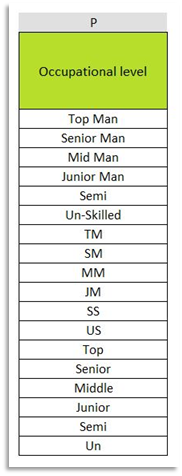
The system will not accept abbreviations.